
August 8, 2026 · 8 min read
JPG to WebP Converter: Why and How to Convert (2026 Guide)
What WebP is, how much smaller it really is than JPEG, when to keep JPG or PNG instead, and how to convert images in your browser — free, no signup.
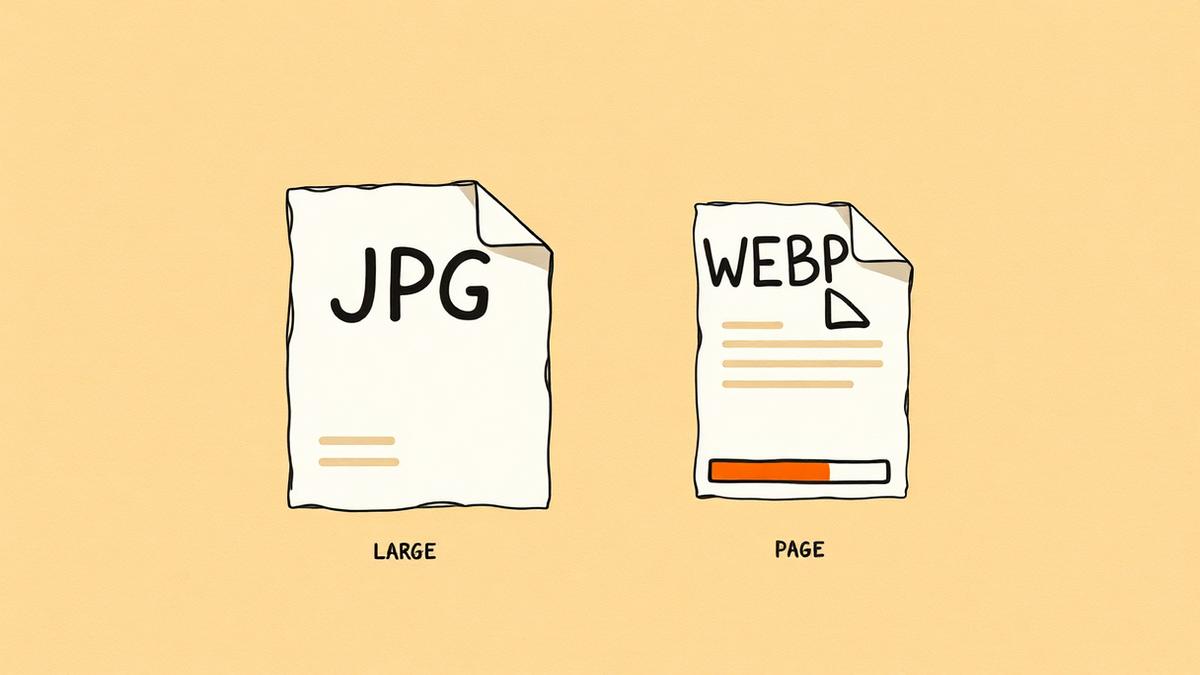
Images are usually the heaviest thing on a web page, and JPEG — designed in 1992 — is no longer the most efficient way to ship them. WebP is the pragmatic upgrade: broadly supported, visually indistinguishable at sensible quality settings, and meaningfully smaller. This guide covers what WebP actually gains you, the cases where JPG or PNG is still the right answer, and how to convert a folder of JPGs in your browser with our Image Converter.
What WebP is
WebP is an image format developed by Google and first released in 2010. It supports lossy compression (like JPEG), lossless compression (like PNG), an alpha channel for transparency, and animation. That combination is unusual: one format covers what previously needed three.
The lossy mode borrows block-prediction techniques from the VP8 video codec, which is why it can describe the same picture with fewer bytes than JPEG's older transform-only approach. Google's own comparative study reports WebP lossy files at roughly 25–34% smaller than JPEG at equivalent SSIM quality, and WebP lossless at around 26% smaller than PNG. Treat those as ballpark figures from the format's authors, not a guarantee — the real saving on your own images depends on the content and the quality setting, and the honest way to know is to convert a few and compare file sizes.
Why it matters: speed, Core Web Vitals, SEO
Smaller images download faster, and on most pages the biggest visible element is an image. That element is what Largest Contentful Paint (LCP) measures — one of Google's Core Web Vitals, and a documented (if lightweight) ranking signal. Google's own performance guidance explicitly recommends serving images in modern formats such as WebP or AVIF as an LCP optimisation.
- Faster first impression. A hero image that is a third smaller starts and finishes painting sooner, especially on mobile data.
- Lower bandwidth costs. On an image-heavy catalogue or gallery, the saving compounds across every page view.
- Better Lighthouse scores. "Serve images in next-gen formats" is a standard Lighthouse opportunity; converting to WebP removes it.
- Same visual result. At a quality setting around 90, most photographs are indistinguishable from the JPEG original at normal viewing size.
Converting is only half the job. If your JPGs are also larger in pixel dimensions than they are ever displayed, resize them first with Image Resize — that usually saves more bytes than the format change does. For a whole folder in one pass, Bulk Image Compress is the faster route.
When to use WebP — and when to keep JPG or PNG
Use WebP for
- Photographs and hero images on your own website, where you control the markup.
- Product galleries, blog images, thumbnails — anywhere volume makes the per-file saving add up.
- Graphics that need transparency but are too photographic for PNG to compress well; WebP handles alpha in lossy mode, which PNG cannot.
- Simple animations you would otherwise ship as a bulky GIF.
Keep JPG or PNG for
- Files you send to other people. Email clients, older desktop software, some CMSes and plenty of print workflows still expect JPG or PNG. A colleague who cannot open your attachment is a worse outcome than a slightly larger file.
- Print. Print shops and design tools standardise on JPEG, TIFF and PDF; WebP is a web format and support in prepress software is patchy.
- Upload targets you do not control. Marketplaces, job portals, government forms and passport-photo uploads frequently accept JPG or PNG only.
- Very old browsers. Every current browser supports WebP — Chrome, Edge, Firefox, Opera and Safari (from Safari 14 / iOS 14, released in 2020). Internet Explorer 11 and pre-14 Safari do not. If your analytics still show a meaningful share of those, serve WebP through a
<picture>element with a JPG fallback rather than replacing the JPG outright. - Archival masters. Keep your original files. WebP conversion is a lossy re-encode; you want the untouched source if you ever need to re-edit.
How to convert JPG to WebP with EasyFileMagic
Our converter runs entirely inside your browser tab. Your images are decoded, redrawn onto a canvas and re-encoded locally — nothing is uploaded to a server, so there is no queue, no account and no daily limit to hit.
- Open the Image Converter. The page loads and then works offline-style — no upload step.
- Drop your JPGs onto the dropzone, or click to browse. You can add as many images as you like in one go; JPG, PNG and WEBP inputs are all accepted.
- Choose WEBP as the output format.
- Click convert. Each image is re-encoded in turn, with progress shown per file.
- A single image downloads directly as
name.webp. Multiple images are bundled into a ZIP so you get the whole batch in one download.
Actual specs, so you know what you are getting
- Where it runs: in your browser, on the HTML canvas API. No upload, no server-side processing.
- Batch: yes — multiple files per run, delivered as a ZIP when there is more than one.
- Size limit: none imposed by us. The practical ceiling is your device's memory, so a desktop copes with much larger images than a phone.
- Signup: none. No account, no email, no watermark.
- Quality: lossy WebP is written at a fixed high quality setting (0.92), chosen to stay visually clean rather than to chase the smallest possible file.
- Metadata: because the image is redrawn onto a canvas, EXIF data such as GPS coordinates and camera details is not carried over. That is a privacy win for web publishing, but keep your originals if you rely on that metadata.
Need to strip metadata from files you are not converting? Use EXIF Remover. Coming from an iPhone library instead? HEIC to JPG gets you to a standard format first.
After converting: actually serving WebP
Converting the files is step one; your site has to reference them. Update the image paths in your CMS or templates, and if you still need to support very old browsers, wrap them:
- Use
<picture>with a WebP<source>and a JPG<img>fallback — browsers that do not understand WebP quietly take the JPG. - Keep explicit
widthandheightattributes so the smaller file does not introduce layout shift (CLS). - Mark your hero image
fetchpriority="high"and leave below-the-fold imagesloading="lazy"; format alone will not fix an LCP problem caused by load order.
Frequently asked questions
- Is WebP really smaller than JPEG?
- Generally yes. Google's comparative study of the format reports WebP lossy images at roughly 25–34% smaller than JPEG at equivalent SSIM quality, and WebP lossless at around 26% smaller than PNG. The saving on any specific image depends on its content and the quality setting, so the reliable test is to convert a few of your own files and compare the sizes.
- Do all browsers support WebP in 2026?
- All current browsers do — Chrome, Edge, Firefox, Opera and Safari, which added support in Safari 14 and iOS 14 back in 2020. The exceptions are Internet Explorer 11 and Safari versions older than 14. If those matter to your audience, serve WebP inside a <picture> element with a JPG fallback.
- Does converting JPG to WebP lose quality?
- Lossy WebP is a re-encode, so it is not pixel-identical to the source — and because the JPG was already lossy, you are compressing twice. In practice, at the high quality setting our converter uses, the difference is not visible at normal viewing size. Always keep your original files rather than converting over them.
- Are my images uploaded when I use your converter?
- No. The Image Converter decodes and re-encodes each image inside your browser tab using the canvas API. Nothing is sent to a server, which is also why there is no file size cap, no daily limit and no signup.
- Can I convert several JPGs to WebP at once?
- Yes. Add as many images as you want in one run; a single file downloads directly as .webp, and multiple files are bundled into a ZIP archive.